On Friday, November 20, Anthropic mathematician Levent Alpöge posted a solution to the Riemann hypothesis that he had found using Claude. By Saturday, the solution had been verified by the Lean and Mathlib communities, marking what could be one of the most significant milestones in modern mathematics. After a tumultuous year of AI-assisted math, we have arrived, ready or not, at what Terence Tao calls the age of “Math 2.0.”
What are the characteristics of Math 2.0? What does it mean for research-level math, once confined to the world of chalkboards, grad seminars, and academic journals, to have reached The New York Times? To understand what it is, how it works, and why we study it, there is no better place to start than SIX MATH ESSENTIALS, Terry’s new book for general readers. And it’s important to recognize that recent AI-generated breakthroughs didn’t happen overnight: They emerged from a history of human-machine collaboration spanning the past decade, as vividly documented in Kevin Hartnett’s THE PROOF IN THE CODE.
Terry has become a trusted voice in reckoning with Math 2.0, appearing in high-profile conversations with The New York Times and The Los Angeles Review of Books, on podcasts such as Conversations with Tyler with host Tyler Cowen, and as a speaker at sold-out talks at the Harvard Science Center, Pioneer Works, and soon, Linda Hall Science Library, upcoming on December 3.
Beyond the problems themselves, Terry draws on the themes in SIX MATH ESSENTIALS to address the philosophical questions that mathematicians are asking. “What does it mean to prove something? What does it mean to understand something? These two statements used to be almost synonymous, but now they’ve been decoupled,” he explains to Tyler Cowen.
On Sunday, November 15, before a crowd of over 500 people at Pioneer Works, he spoke with Barnard professor Janna Levin about the beauty and intuition of mathematics.
The hour-plus discussion covered an array of topics from SIX MATH ESSENTIALS. Children playing the “biggest number” game will prove that the number line is infinite. The unsolved (as of now!) Collatz conjecture, which Terry wryly dubbed a “math disease,” can infect everyone from grade schoolers to seasoned mathematicians with the urge to solve it. He couldn’t recall any Eureka moments—simply the realization, “Why didn’t I see this before?” Math, from his lens, is a way of seeing: modeling the world, hypothesizing within it, understanding it deeper. Far from opaque, far from obscure, it’s a language for everyone and everything.
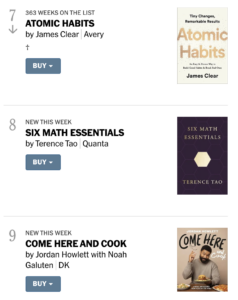 We’re thrilled that SIX MATH ESSENTIALS is an instant New York Times bestseller! The book, praised by 3Blue1Brown’s Grant Sanderson as a “beautiful distillation [of] the essence of math,” debuted at #8 on the Advice, How-To & Miscellaneous list and at #25 on Publishers Weekly’s hardcover nonfiction bestseller list.
Meanwhile, THE PROOF IN THE CODE has been selected as one of Publishers Weekly’s Best Books of 2026.
Congratulations to Terry and Kevin!
With the influx of inelegant, often inscrutable AI proofs, Kevin Hartnett’s THE PROOF IN THE CODE continues to be timely. Tracing the development of Lean, the once-niche coding language now at the forefront of proof verification, the book recounts the fast-paced, illuminating, and premonitory story that led up to this transformation in math.
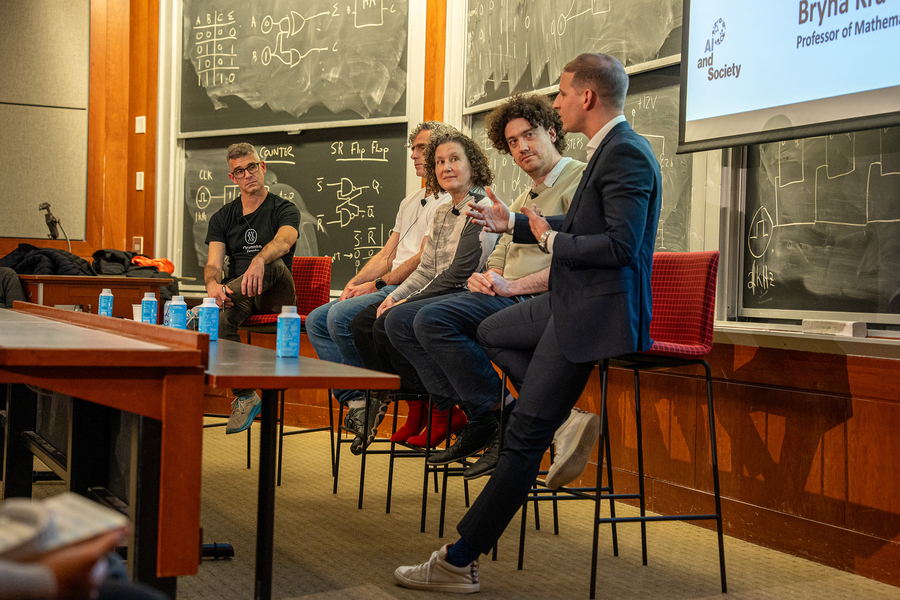
Kevin himself has followed Lean since its inception, publishing early articles in Quanta Magazine about what it is now on the verge of becoming. He recently appeared on the MIT panel “AI and Society: The Future of Math” as a moderator, and will speak at Harvard Science Center on December 1 about THE PROOF IN THE CODE and the shifting notion of truth in the new math-AI paradigm.
The announced proof of the Riemann hypothesis will ripple far beyond the current headlines. Looking into the future, we can return to Terry’s metaphor, shared with the audience at Pioneer Works: Mathematics is like a series of mountain peaks breaking through the fog. Most people only see individual peaks. Yet the deeper we travel, the more we find valleys, connecting everything into a single terrain.
Like mathematicians in the sixteenth century connecting the peaks of algebra and geometry, we are still discovering the pathways between the Math 1.0 of the past millennia and the Math 2.0 that AI has been extracting from the clouds.
As the ground shifts below, there’s no better way to find our footing than to pick up a good book.