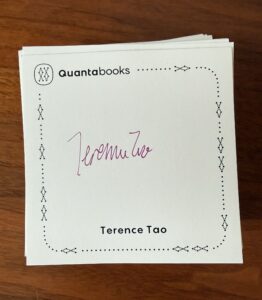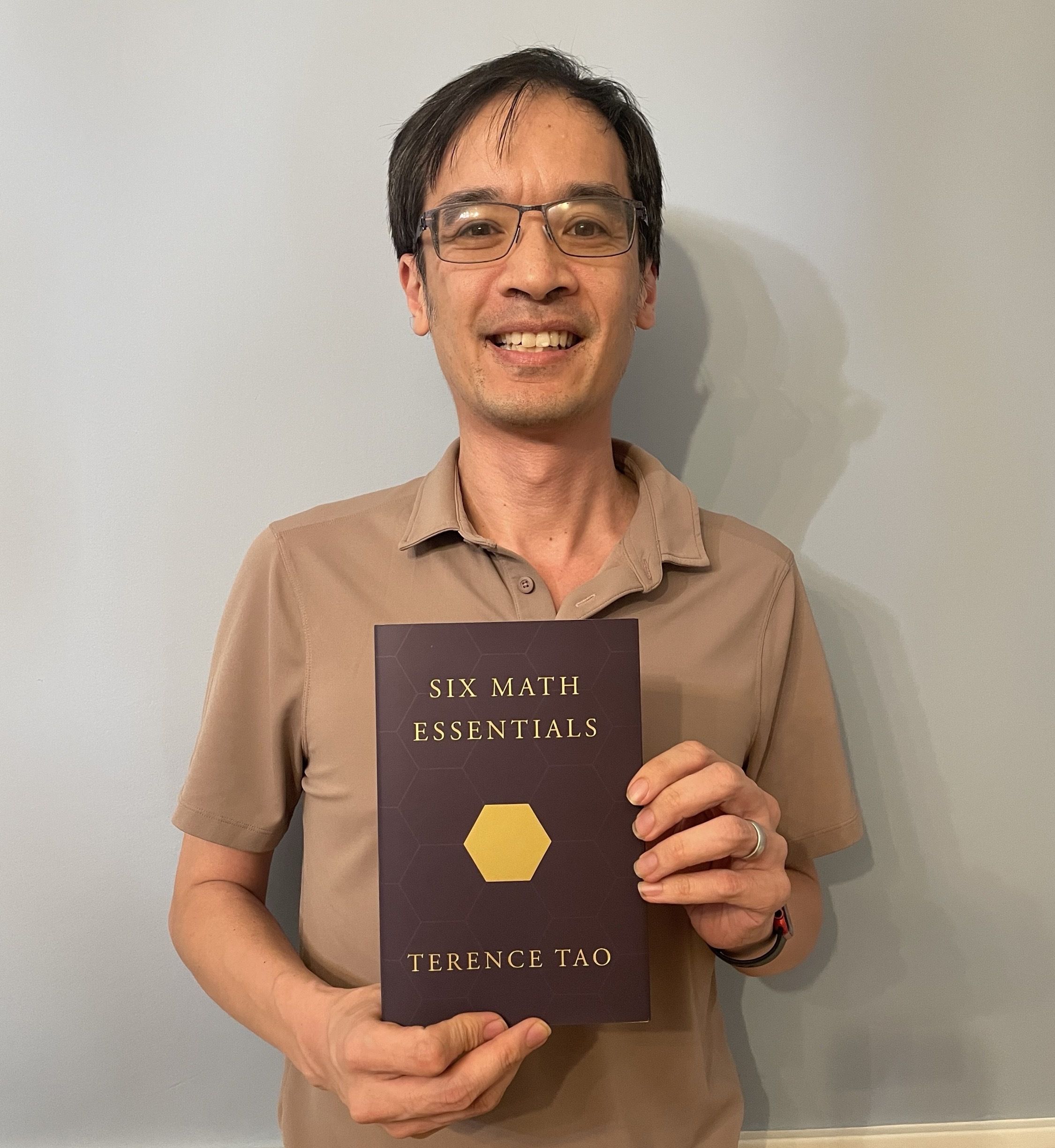
While laying the groundwork for Quanta Books in 2023, I started forming a mental wish list of authors I most wanted to publish. It didn’t matter whether they had ever written a popular science book. David Tong was high on the list. So were Kevin Hartnett and Shruti Naik. But the first name that came to mind was Terence Tao.
I first became aware of Terry in 1985, after reading a newspaper article about a 9-year-old Australian prodigy who was taking college math courses and had scored 760 on the math section of the SAT a year earlier. In the years since, I marveled as Terry became the youngest ever gold medalist at the International Mathematical Olympiad, went on to win a Fields Medal, and established himself as one of the most prolific and accomplished mathematicians of his generation. I gained a deeper appreciation for Terry’s interest in prime numbers, the Collatz conjecture, and large math collaborations like the Polymath project, when I assigned and edited several Quanta Magazine articles featuring his work and ideas, and proposed him as a guest on the Joy of Why podcast.
Wouldn’t it be great, I thought, if Terry wrote a short, welcoming book that conveys the essence of six key areas of math, giving readers—in simple, elegant, nontechnical language—an indispensable primer about the mathematical enterprise and the power, beauty and interconnectedness of its ideas? In early 2025, I got 15 minutes to pitch him the book concept over coffee. (After all, as long ago established by Alfred Renyi, “a mathematician is a machine for turning coffee into theorems.”) Terry’s response: “I am tentatively interested but I have close to zero bandwidth for the next few months.”
Needless to say, I followed up. That June, we met at UCLA, and over the following months, we shaped, edited, revised, and honed each chapter. I had the time of my life, feeling—as Ben Orlin (the bestselling author of Math with Bad Drawings) said after reading the manuscript—both like I was “seeing soccer through Messi’s eyes” and “like a kid riding on the shoulders of the world’s smartest grown-up.”
Terry never explicitly told me why he decided to write this book. But he recently told Flora Lichtman on Science Friday, “I wanted to convey in my book that the type of things that research mathematicians do these days, either in pure math or in applications to the real world, is still tied to the basic concepts that you already are exposed to as a child—numbers, shapes, time, change, big and small. We give them fancy words. The mathematics of big and small numbers, we call analysis. The mathematics of change, we call dynamics. But it all comes from very basic concepts that you’ve seen in primary school.”
Today, I’m thrilled to share Terry’s SIX MATH ESSENTIALS with readers across the U.S. and North America. The book, to me, is a gift. It is a gift of mathematical ideas and understanding from “one of the great mathematicians of our time—and also one of the most generous,” as the math professor and bestselling author Steven Strogatz described Terry. It is a gift to my teenage self (oh how I wish such a book had existed then), when I was learning the mechanics of high school math but didn’t yet know why I was doing it or what it all meant. It is also a gift of empowerment, since, as Terry writes in his epilogue, “having some understanding of what mathematics is, and how it connects to the world, can provide some serenity, reassurance, and perspective on the complexity we see around us.”
For readers outside North America, a UK edition (Penguin UK) has already been released and 19 translated editions are planned, each with its own publication schedule: France (Albin Michel), South Korea (Woongjin), Spain (Acantilado), China (CITIC), Greece (Katoptro), Japan (Soshisha), Italy (Adelphi), Poland (Insignis), Taiwan (EcoTrend Publications), Netherlands (Atlas Contact), Croatia (Izvori), Hungary (Typotex), Czech (Euromedia Group), Estonia (Uhinenud), Turkey (Pegasus), Vietnam (Tre Publishing), Portugal (Leya), Romania (Curtea Veche Publishing), Ukraine (Stone Publishing).